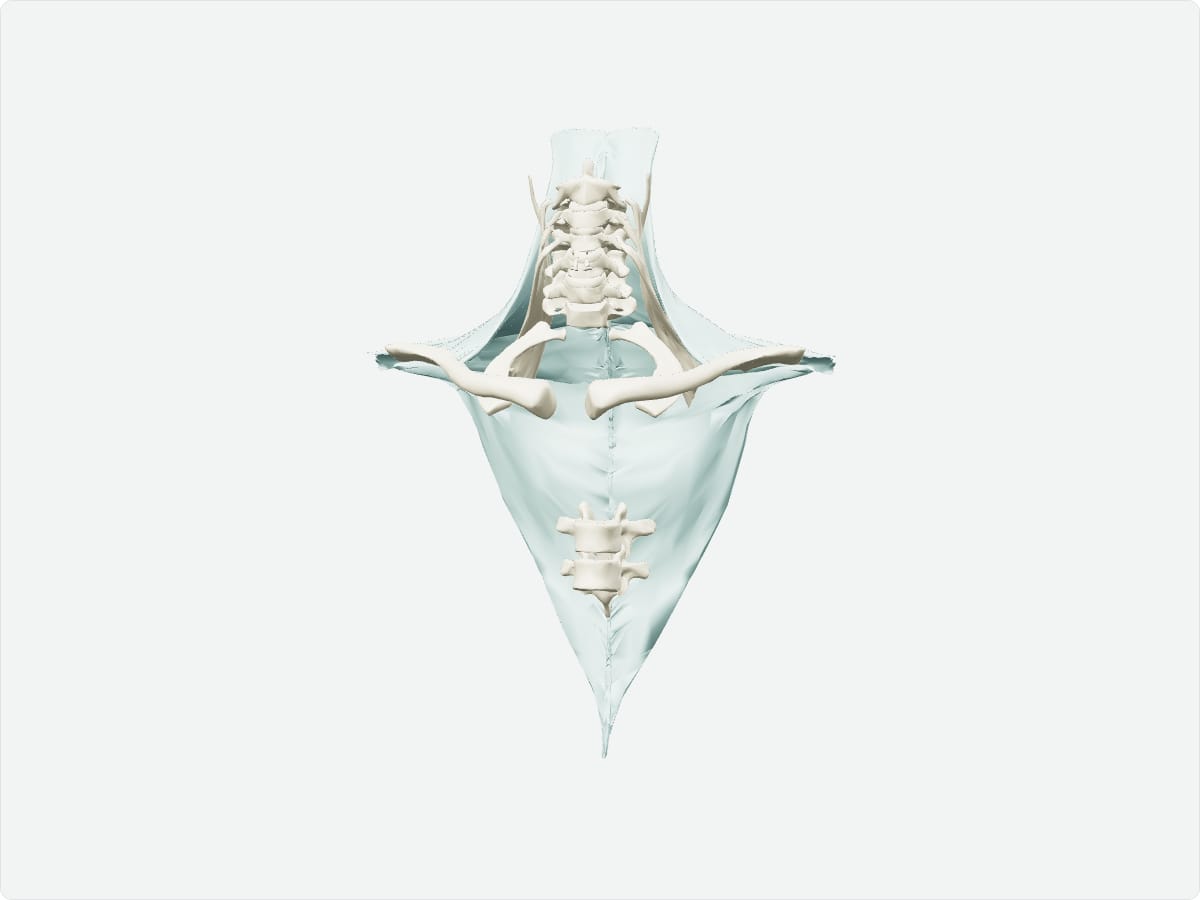
Trapezius: origin, insertion, nerve supply and action
Also called: traps, trapezius muscle
Quick answer
The trapezius is a large triangular muscle covering the upper back and back of the neck. It arises from the occiput, the nuchal ligament and the spinous processes of C7 to T12, and inserts on the lateral clavicle, acromion and spine of the scapula. The spinal accessory nerve supplies it. It elevates, retracts and depresses the scapula and rotates it upward.
Key facts
Origin
Medial third of the superior nuchal line, external occipital protuberance, nuchal ligament and spinous processes of C7 to T12.
Insertion
Lateral third of the clavicle, acromion and spine of the scapula.
Innervation
Spinal accessory nerve (cranial nerve XI) for motor; C3-C4 for pain and proprioception.
Blood supply
Superficial branch of the transverse cervical artery, dorsal scapular artery and occipital artery.
Action
Upper fibres elevate the scapula, middle fibres retract it, lower fibres depress it; upper and lower fibres together rotate the scapula upward for arm abduction.
3D model: BodyParts3D (CC BY 4.0), adult male reference anatomy. Highlighted structure shown with nearby bones for context.
About the trapezius
The atlas models the trapezius as descending, transverse and ascending parts, corresponding to the upper, middle and lower fibres. The muscle is the most superficial of the upper back muscles.
Together with the levator scapulae and rhomboids it positions the scapula so the shoulder joint can move effectively.
Clinical relevance
Damage to the spinal accessory nerve, for example during neck surgery, causes shoulder droop and difficulty abducting the arm above horizontal.
Upper trapezius trigger points are a common source of neck and shoulder tension.
Frequently asked questions
What nerve supplies the trapezius?
The spinal accessory nerve (cranial nerve XI).
What are the three parts of the trapezius?
The descending (upper), transverse (middle) and ascending (lower) parts, which have different actions on the scapula.