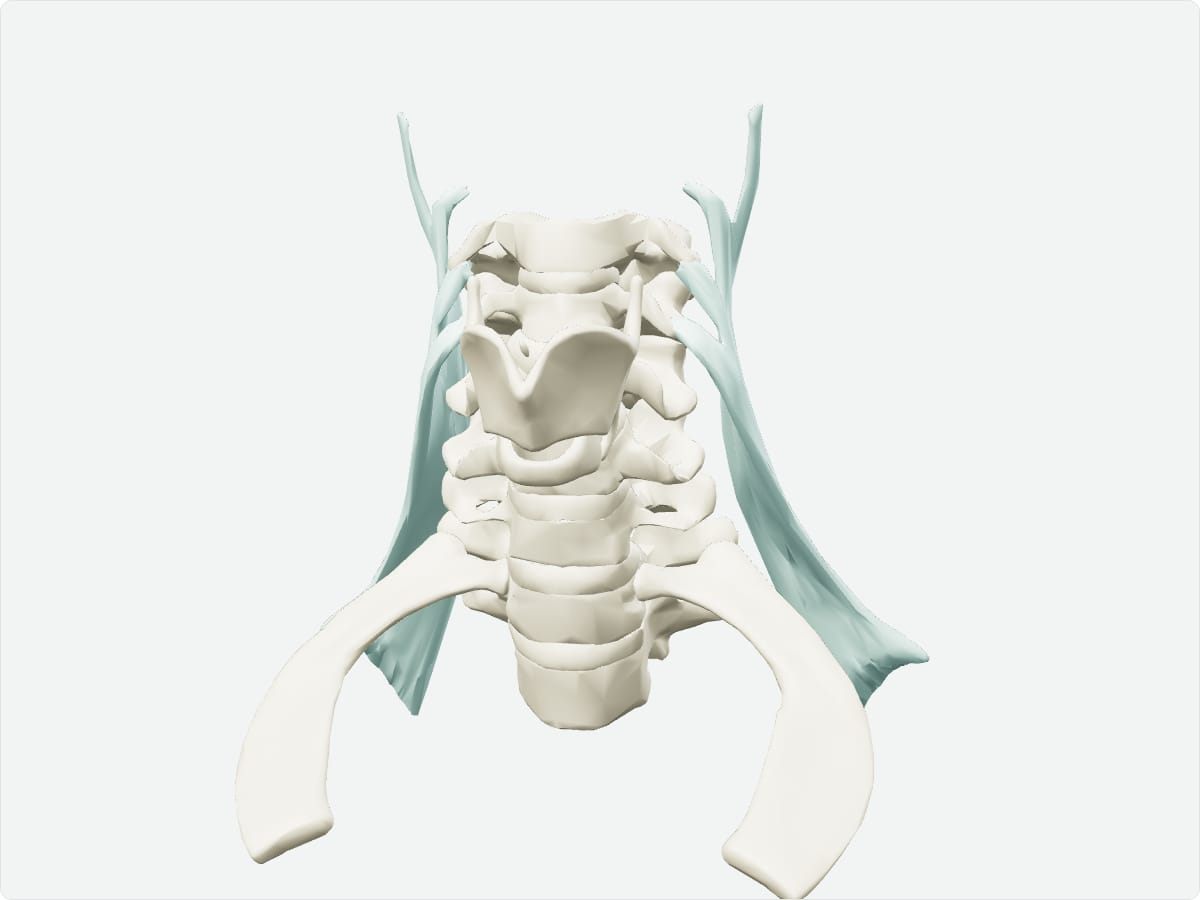
Levator scapulae: origin, insertion, nerve supply and action
Quick answer
The levator scapulae is a strap-like muscle at the back and side of the neck. It arises from the transverse processes of the upper four cervical vertebrae and inserts on the superior angle and upper medial border of the scapula. The dorsal scapular nerve and cervical nerves supply it. It elevates the scapula and rotates it downward.
Key facts
Origin
Posterior tubercles of the transverse processes of C1 to C4.
Insertion
Superior angle and medial border of the scapula above the scapular spine.
Innervation
Dorsal scapular nerve (C5) and cervical spinal nerves C3-C4.
Blood supply
Dorsal scapular artery and transverse cervical artery.
Action
Elevates the scapula and rotates the glenoid cavity downward; when the scapula is fixed it bends the neck to the same side.
3D model: BodyParts3D (CC BY 4.0), adult male reference anatomy. Highlighted structure shown with nearby bones for context.
About the levator scapulae
The levator scapulae lies deep to the trapezius and sternocleidomastoid. It is a common source of stiff neck symptoms after sustained postures such as prolonged desk work.
Clinical relevance
Levator scapulae strain is a frequent cause of pain at the angle between the neck and shoulder.
Frequently asked questions
What does the levator scapulae do?
It lifts the scapula and helps rotate it downward, as in shrugging.
Where does the levator scapulae attach?
It arises from the transverse processes of C1 to C4 and inserts on the superior angle and upper medial border of the scapula.