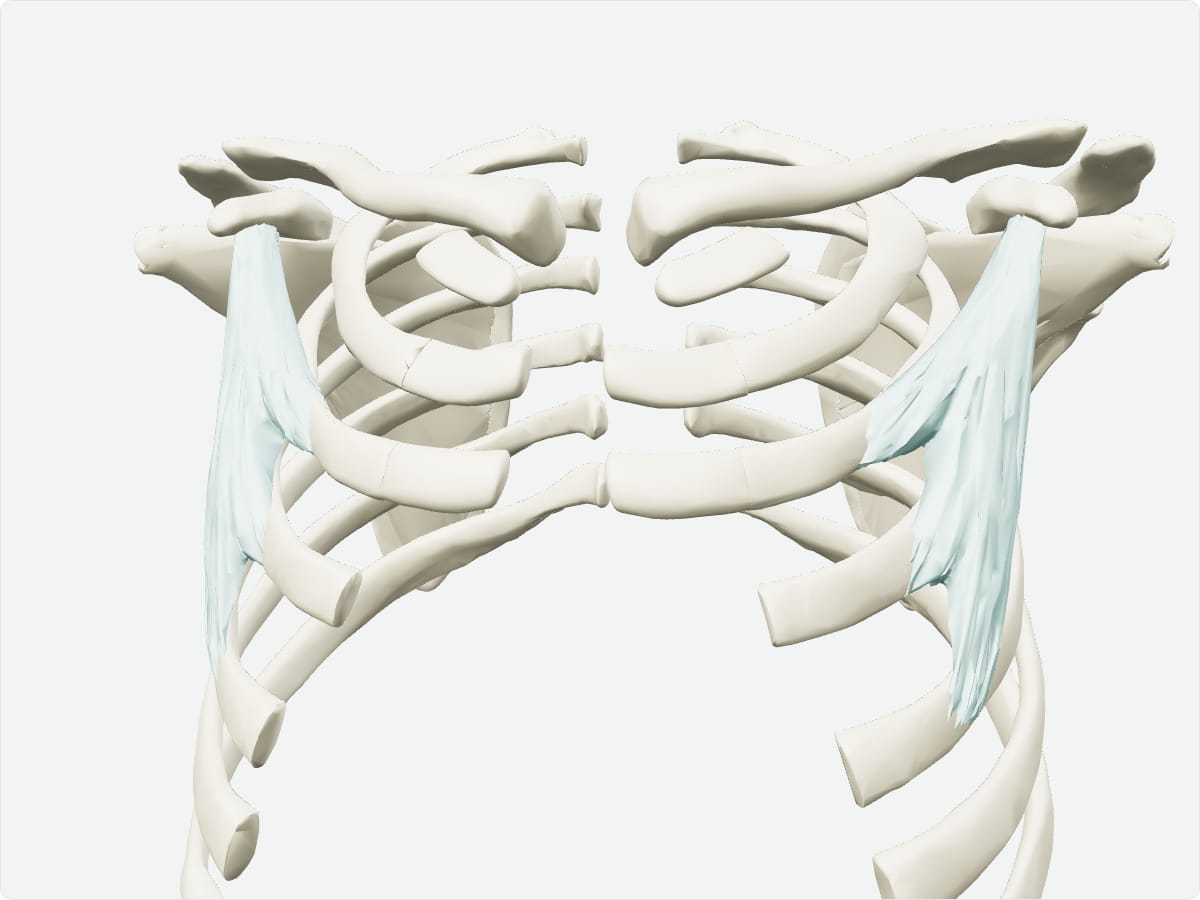
Pectoralis minor: origin, insertion, nerve supply and action
Also called: pec minor
Quick answer
The pectoralis minor is a thin triangular muscle beneath the pectoralis major. It arises from ribs three to five and inserts on the coracoid process of the scapula. The medial pectoral nerve supplies it, and it draws the scapula forward and down; with the scapula fixed it can lift the ribs in forced inspiration.
Key facts
Origin
External surfaces of the third to fifth ribs near their costal cartilages.
Insertion
Medial border and upper surface of the coracoid process of the scapula.
Innervation
Medial pectoral nerve (C8-T1), with a contribution from the lateral pectoral nerve.
Blood supply
Pectoral branch of the thoracoacromial artery and lateral thoracic artery.
Action
Protracts and depresses the scapula; elevates the ribs in forced inspiration when the scapula is fixed.
3D model: BodyParts3D (CC BY 4.0), adult male reference anatomy. Highlighted structure shown with nearby bones for context.
About the pectoralis minor
The pectoralis minor crosses the axillary vessels and brachial plexus. Surgeons divide the axilla into three parts using this muscle as the reference: parts one, two and three lie above, behind and below it.
Tightness of the muscle can alter scapular position and contribute to a forward-rounded shoulder posture.
Clinical relevance
Pectoralis minor syndrome is a form of neurogenic thoracic outlet syndrome caused by compression of the brachial plexus behind the muscle.
Frequently asked questions
Where does pectoralis minor insert?
On the coracoid process of the scapula.
What is the action of pectoralis minor?
It pulls the scapula forward and down and can raise the ribs in deep breathing.