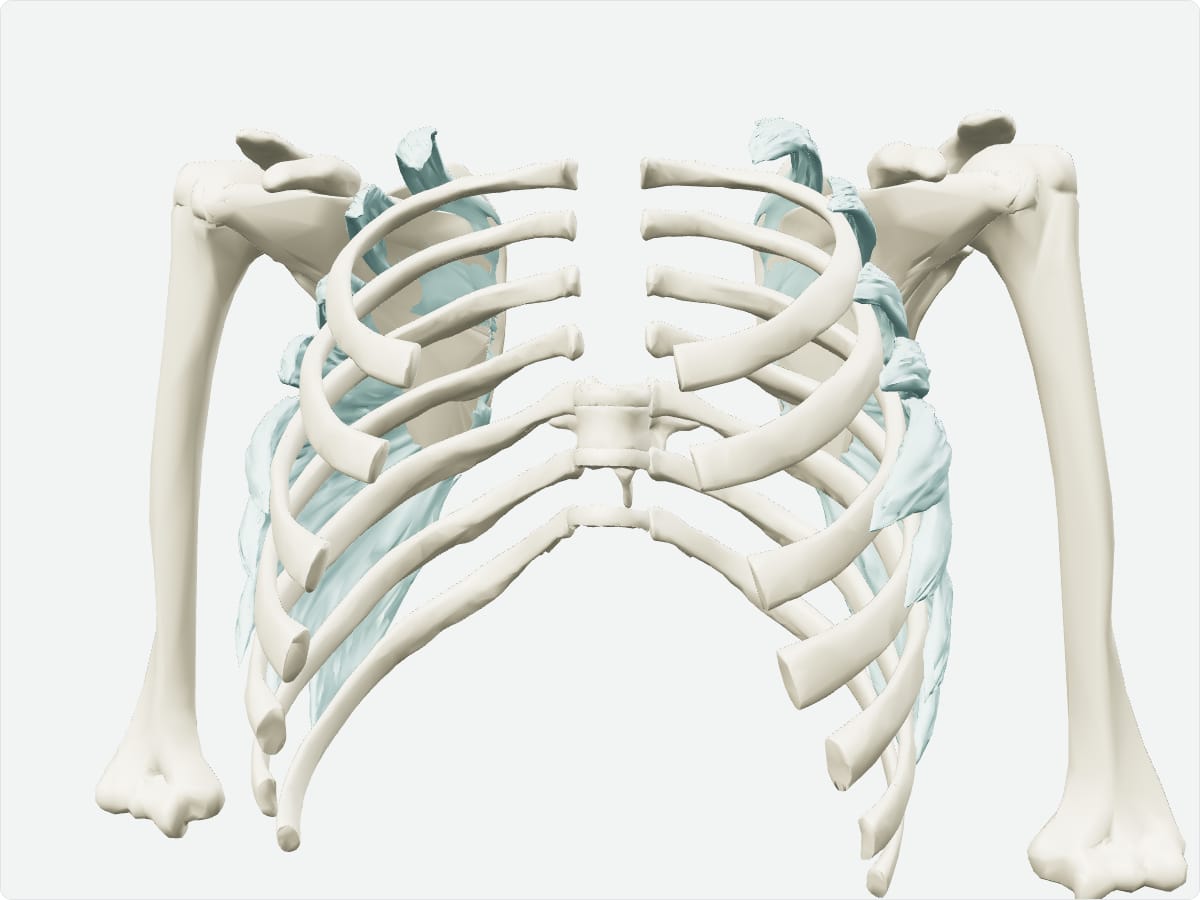
Serratus anterior: origin, insertion, nerve supply and action
Also called: boxer's muscle
Quick answer
The serratus anterior is a broad sheet of muscle on the side of the chest wall. It arises from the outer surfaces of the upper eight or nine ribs and inserts on the anterior surface of the medial border of the scapula. The long thoracic nerve supplies it. It protracts the scapula, rotates it upward and holds it against the chest wall.
Key facts
Origin
External surfaces of the upper eight or nine ribs by fleshy slips.
Insertion
Costal (anterior) surface of the medial border of the scapula, with the largest attachment at the inferior angle.
Innervation
Long thoracic nerve (C5-C7).
Blood supply
Lateral thoracic artery and thoracodorsal artery.
Action
Protracts the scapula, rotates it upward to allow arm elevation above the horizontal, and keeps the medial border against the thorax.
3D model: BodyParts3D (CC BY 4.0), adult male reference anatomy. Highlighted structure shown with nearby bones for context.
About the serratus anterior
Its serrated slips of origin give the muscle its name and are visible on the lateral chest of lean individuals. Together with the trapezius it rotates the scapula so that the arm can be raised overhead.
The long thoracic nerve runs on its outer surface, which makes it vulnerable during axillary surgery.
Clinical relevance
Long thoracic nerve injury causes a winged scapula, where the medial border lifts off the chest when the outstretched arm is pushed forward against resistance.
Frequently asked questions
What causes a winged scapula?
The most common cause is injury to the long thoracic nerve, which paralyses serratus anterior.
Where does the serratus anterior originate?
From the outer surfaces of the upper eight or nine ribs.