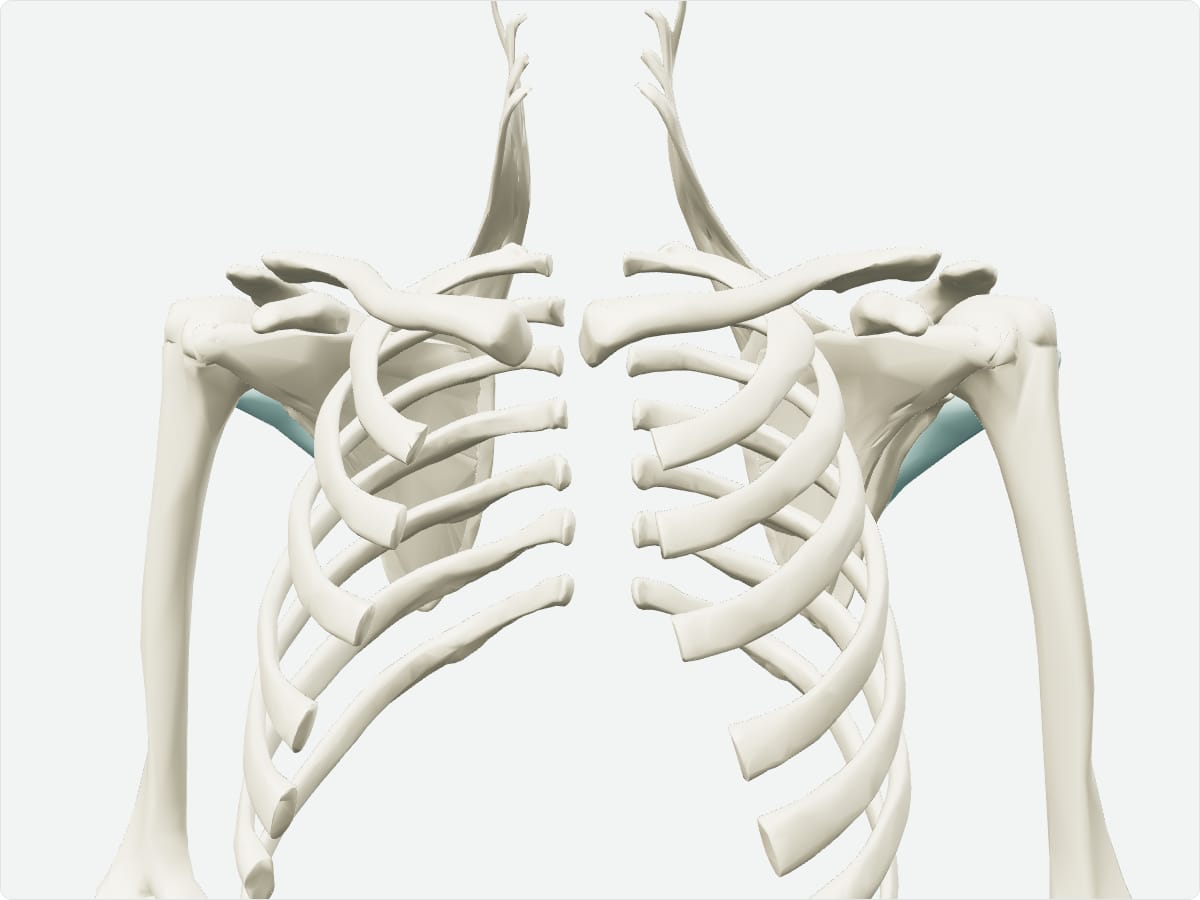
Teres minor: origin, insertion, nerve supply and action
Also called: teres minor muscle
Quick answer
The teres minor is a small rotator cuff muscle on the back of the shoulder. It arises from the upper two thirds of the lateral border of the scapula and inserts on the inferior facet of the greater tubercle of the humerus. The axillary nerve supplies it, and it laterally rotates the arm and stabilises the shoulder.
Key facts
Origin
Upper two thirds of the dorsal surface of the lateral border of the scapula.
Insertion
Inferior facet of the greater tubercle of the humerus.
Innervation
Axillary nerve (C5-C6).
Blood supply
Circumflex scapular artery and posterior circumflex humeral artery.
Action
Laterally rotates the arm; weakly adducts; holds the humeral head in the glenoid cavity.
3D model: BodyParts3D (CC BY 4.0), adult male reference anatomy. Highlighted structure shown with nearby bones for context.
About the teres minor
The teres minor forms the upper boundary of the quadrangular space (with subscapularis and the surgical neck of the humerus) through which the axillary nerve and posterior circumflex humeral vessels pass.
It lies just above the teres major and is separated from it by the long head of the triceps.
Clinical relevance
Because the axillary nerve supplies both teres minor and deltoid, teres minor atrophy can accompany quadrangular space syndrome.
Frequently asked questions
Is teres minor a rotator cuff muscle?
Yes. With supraspinatus, infraspinatus and subscapularis, it forms the rotator cuff.