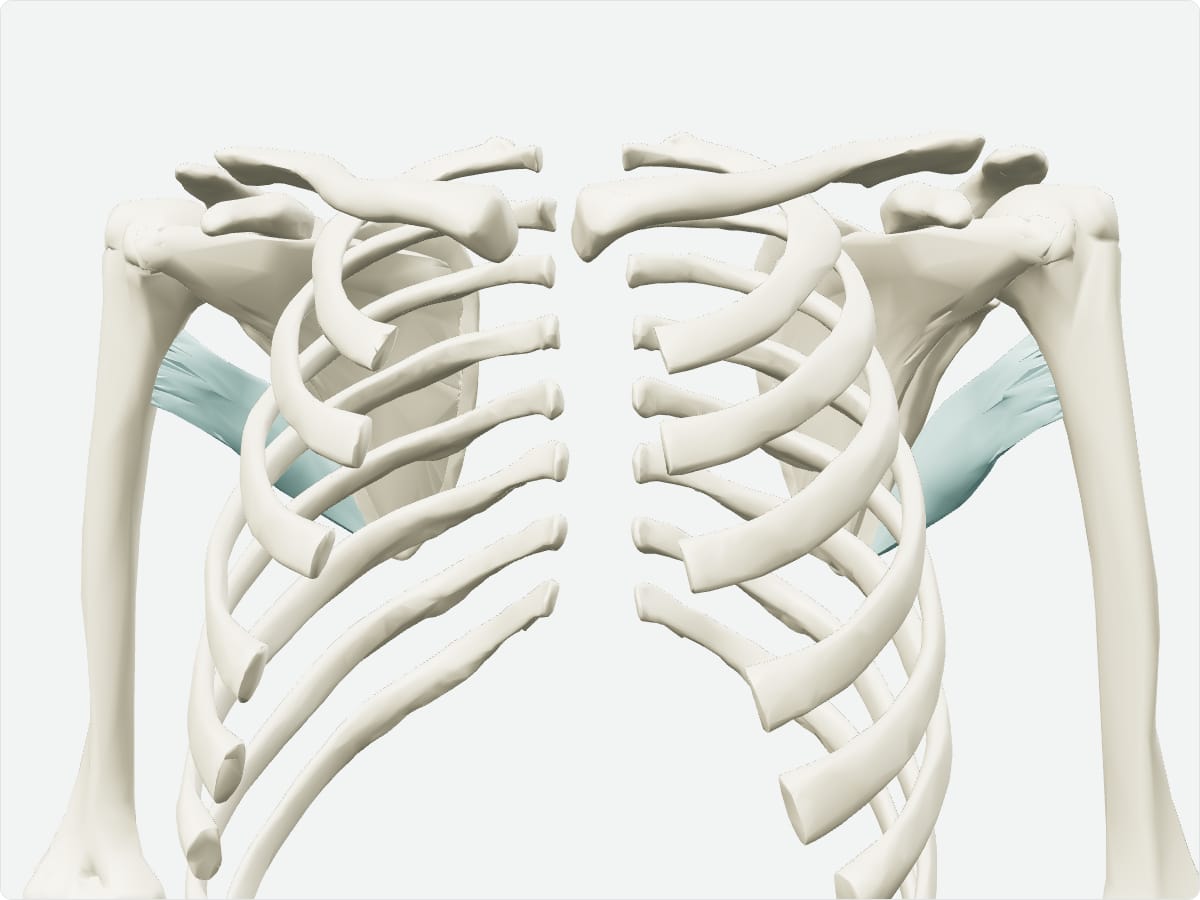
Teres major: origin, insertion, nerve supply and action
Also called: teres major muscle
Quick answer
The teres major is a thick muscle that runs from the inferior angle of the scapula to the humerus. It inserts on the medial lip of the intertubercular sulcus. The lower subscapular nerve supplies it, and it adducts, medially rotates and extends the arm.
Key facts
Origin
Dorsal surface of the inferior angle of the scapula.
Insertion
Medial lip of the intertubercular sulcus of the humerus.
Innervation
Lower subscapular nerve (C5-C6).
Blood supply
Circumflex scapular artery.
Action
Adducts, medially rotates and extends the arm.
3D model: BodyParts3D (CC BY 4.0), adult male reference anatomy. Highlighted structure shown with nearby bones for context.
About the teres major
The teres major is not part of the rotator cuff. It forms the inferior boundary of the quadrangular and triangular spaces on the back of the shoulder and lies alongside the latissimus dorsi tendon, which it accompanies to the humerus.
It assists latissimus dorsi in pulling the arm down and back.
Clinical relevance
The teres major is often used as a landmark when locating the axillary nerve and the radial nerve on the posterior arm.
Frequently asked questions
Is teres major part of the rotator cuff?
No. The rotator cuff includes supraspinatus, infraspinatus, teres minor and subscapularis.
What is the action of teres major?
Adduction, medial rotation and extension of the arm.