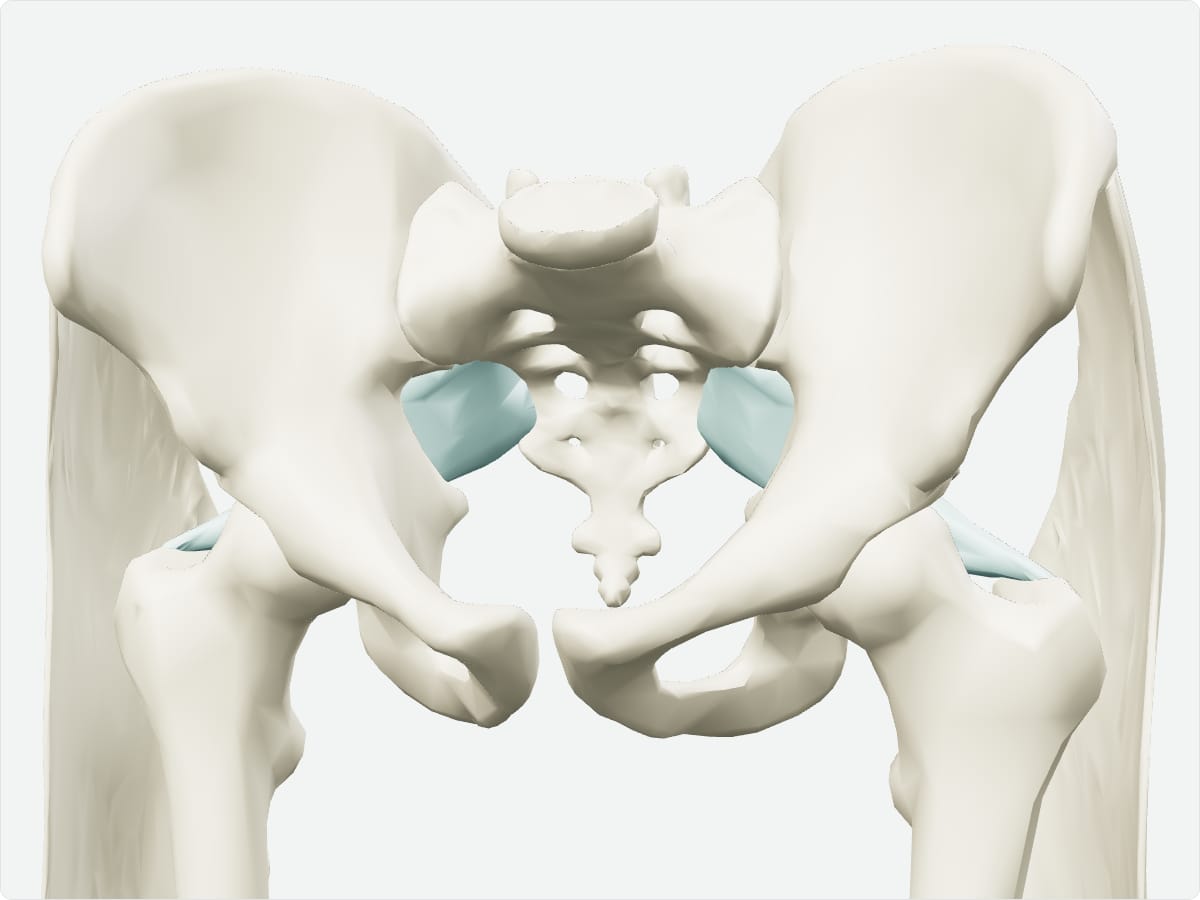
Piriformis: origin, insertion, nerve supply and action
Quick answer
The piriformis is a pear-shaped muscle deep in the buttock. It arises from the anterior surface of the sacrum and inserts on the upper border of the greater trochanter. The nerve to piriformis (S1-S2) supplies it, and it laterally rotates the extended hip. It is the key landmark of the gluteal region.
Key facts
Origin
Anterior surface of the sacrum (S2-S4) and the margin of the greater sciatic notch.
Insertion
Superior border of the greater trochanter of the femur.
Innervation
Nerve to piriformis (L5-S2).
Blood supply
Superior and inferior gluteal arteries.
Action
Laterally rotates the extended hip and abducts the flexed hip.
3D model: BodyParts3D (CC BY 4.0), adult male reference anatomy. Highlighted structure shown with nearby bones for context.
About the piriformis
The piriformis leaves the pelvis through the greater sciatic foramen and divides it into a suprapiriform and an infrapiriform part. The sciatic nerve usually leaves below the muscle.
Clinical relevance
Piriformis syndrome describes buttock pain and sciatica-like symptoms attributed to compression of the sciatic nerve by the muscle; the diagnosis remains debated.
Frequently asked questions
Why is the piriformis important?
It is the landmark that organises the vessels and nerves leaving the pelvis through the greater sciatic foramen.