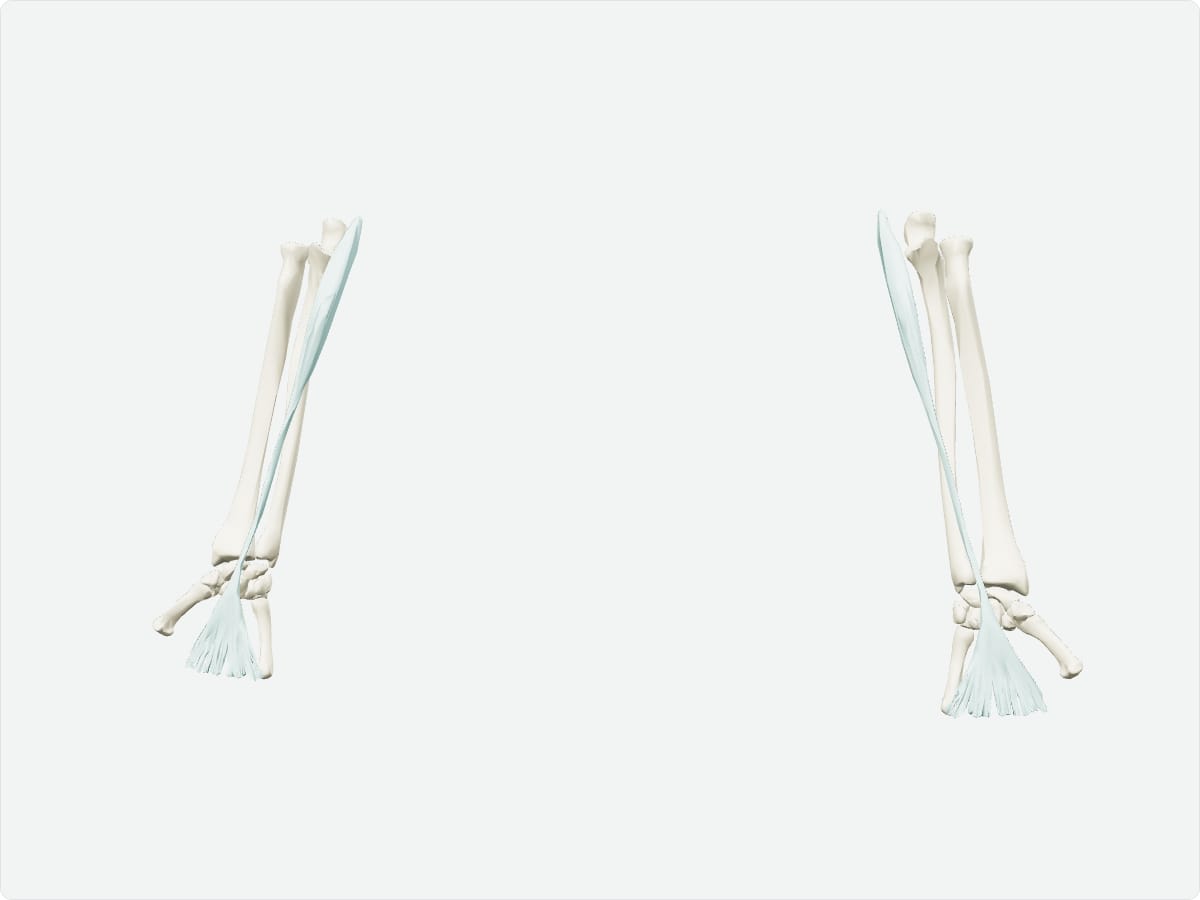
Palmaris longus: origin, insertion, nerve supply and action
Quick answer
The palmaris longus is a slender forearm muscle with a long tendon that is absent in a minority of people. It arises from the medial epicondyle of the humerus and inserts on the flexor retinaculum and palmar aponeurosis. The median nerve supplies it, and it weakly flexes the wrist.
Key facts
Origin
Common flexor origin on the medial epicondyle of the humerus.
Insertion
Flexor retinaculum and palmar aponeurosis.
Innervation
Median nerve (C7-C8).
Blood supply
Ulnar artery.
Action
Weakly flexes the wrist and tenses the palmar aponeurosis.
3D model: BodyParts3D (CC BY 4.0), adult male reference anatomy. Highlighted structure shown with nearby bones for context.
About the palmaris longus
The palmaris longus is absent on one or both sides in roughly 15 percent of people, with variation between populations. Its absence causes no functional problem.
Clinical relevance
Because it is expendable, the tendon is a common donor for tendon grafts and reconstructive surgery.
Frequently asked questions
Is it normal to lack a palmaris longus?
Yes. It is absent in a minority of people and its absence does not weaken the hand in any noticeable way.
Why is the palmaris longus tendon used for grafts?
It is long, easily harvested and its loss has minimal effect on function.