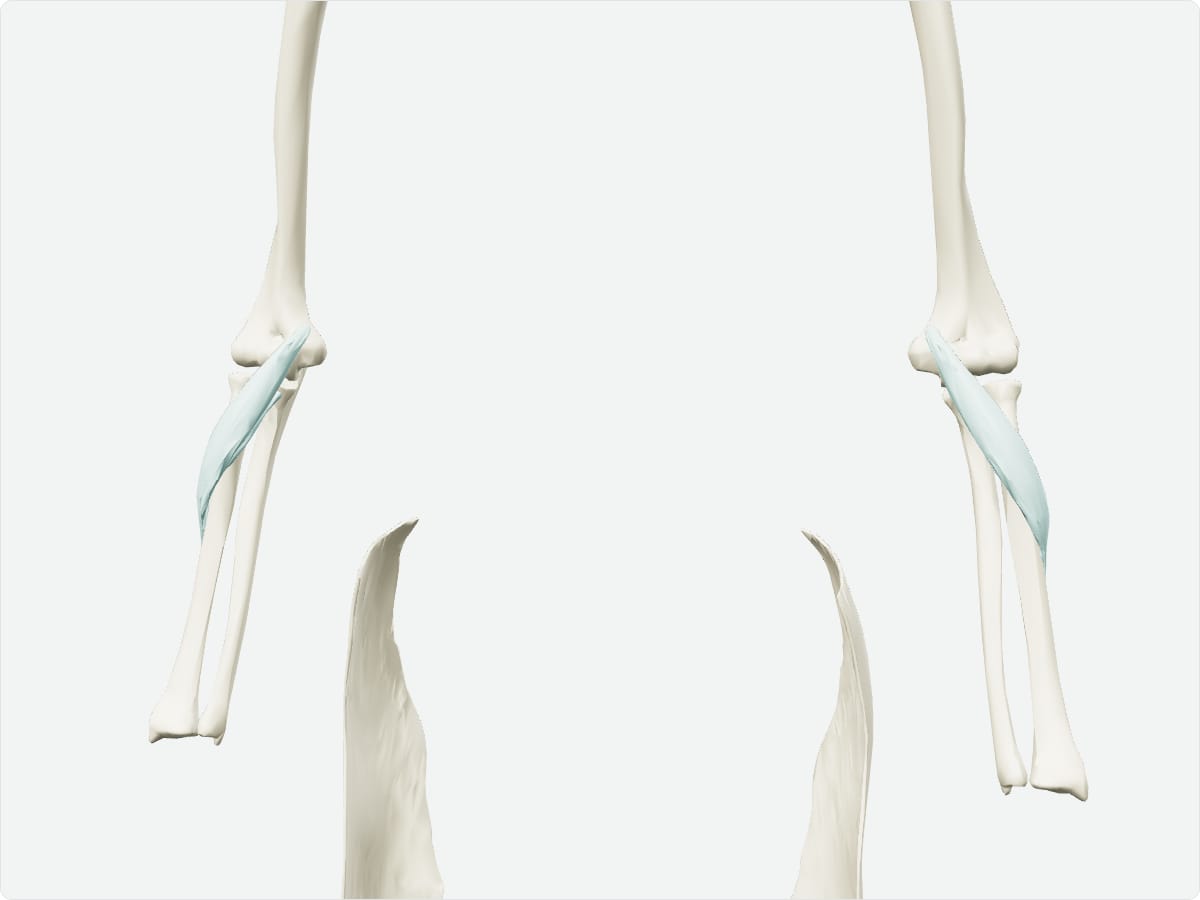
Pronator teres: origin, insertion, nerve supply and action
Quick answer
The pronator teres is a forearm muscle that turns the palm downward. Its humeral head arises from the medial epicondyle and its ulnar head from the coronoid process of the ulna. It inserts on the lateral radial shaft. The median nerve supplies it.
Key facts
Origin
Humeral head: medial epicondyle of the humerus. Ulnar head: coronoid process of the ulna.
Insertion
Pronator tuberosity on the middle of the lateral surface of the radius.
Innervation
Median nerve (C6-C7).
Blood supply
Ulnar artery and radial artery.
Action
Pronates the forearm and weakly flexes the elbow.
3D model: BodyParts3D (CC BY 4.0), adult male reference anatomy. Highlighted structure shown with nearby bones for context.
About the pronator teres
The median nerve passes between the two heads of the pronator teres, and the muscle forms the medial border of the cubital fossa.
Clinical relevance
Pronator syndrome is compression of the median nerve at the level of the muscle, causing forearm pain and hand numbness.