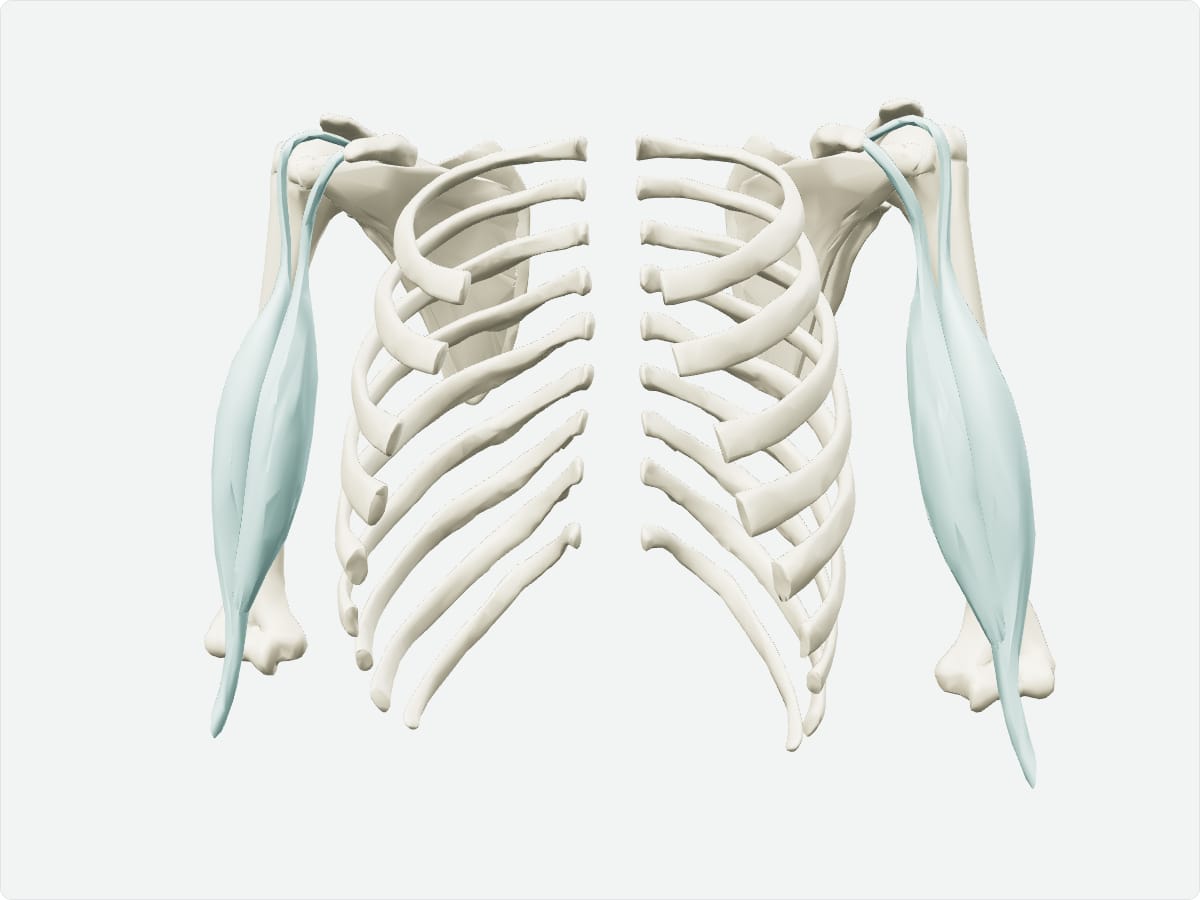
Biceps brachii: origin, insertion, nerve supply and action
Also called: biceps, biceps muscle
Quick answer
The biceps brachii is a two-headed muscle on the front of the upper arm. The short head arises from the coracoid process and the long head from the supraglenoid tubercle of the scapula. It inserts on the radial tuberosity and, through the bicipital aponeurosis, on the forearm fascia. The musculocutaneous nerve supplies it, and it flexes the elbow and supinates the forearm.
Key facts
Origin
Short head: tip of the coracoid process of the scapula. Long head: supraglenoid tubercle of the scapula.
Insertion
Radial tuberosity; bicipital aponeurosis into the deep fascia of the medial forearm.
Innervation
Musculocutaneous nerve (C5-C6).
Blood supply
Muscular branches of the brachial artery.
Action
Flexes the elbow and supinates the forearm (strongest with the elbow bent); weakly flexes the shoulder; the long head helps stabilise the shoulder joint.
3D model: BodyParts3D (CC BY 4.0), adult male reference anatomy. Highlighted structure shown with nearby bones for context.
About the biceps brachii
The biceps brachii lies in the anterior compartment of the arm, superficial to the brachialis. Its two heads join into a single belly at mid-arm, and the tendon of the long head runs through the intertubercular groove of the humerus inside the shoulder joint capsule.
Because it crosses both the shoulder and the elbow, the biceps acts on two joints. Its role as a supinator is why turning a screwdriver clockwise with the right hand is easier with the elbow bent.
Clinical relevance
Rupture of the long head tendon produces a bunched-up muscle belly known as the Popeye sign.
Distal biceps tendon rupture typically follows sudden eccentric loading and weakens supination more than elbow flexion.
The biceps reflex tests spinal segments C5-C6.
Frequently asked questions
What are the origin and insertion of the biceps brachii?
The long head originates from the supraglenoid tubercle and the short head from the coracoid process of the scapula. Both heads insert on the radial tuberosity, with an extension called the bicipital aponeurosis to the forearm fascia.
Which nerve supplies the biceps brachii?
The musculocutaneous nerve, carrying fibres from spinal segments C5 and C6.
What movements does the biceps perform?
It flexes the elbow and supinates the forearm, and it contributes weakly to flexion of the shoulder.