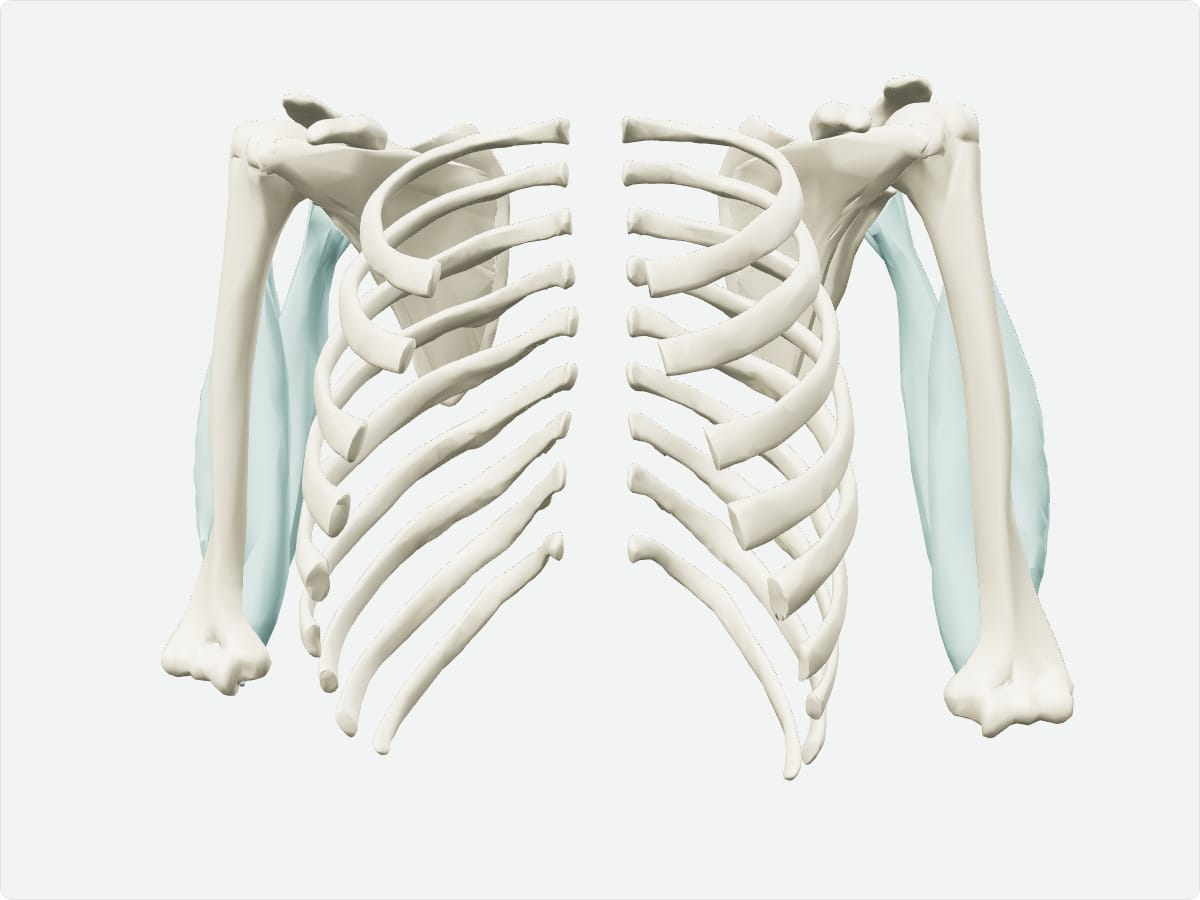
Triceps brachii: origin, insertion, nerve supply and action
Also called: triceps, triceps muscle
Quick answer
The triceps brachii is the three-headed muscle of the back of the upper arm. The long head arises from the infraglenoid tubercle of the scapula, and the lateral and medial heads arise from the posterior humerus. All three insert on the olecranon of the ulna. The radial nerve supplies it, and it extends the elbow.
Key facts
Origin
Long head: infraglenoid tubercle of the scapula. Lateral head: posterior humerus above the radial groove. Medial head: posterior humerus below the radial groove.
Insertion
Posterior surface of the olecranon of the ulna through a common tendon.
Innervation
Radial nerve (C6-C8).
Blood supply
Profunda brachii artery and muscular branches of the posterior circumflex humeral artery.
Action
Extends the elbow; the long head also extends and adducts the arm at the shoulder.
3D model: BodyParts3D (CC BY 4.0), adult male reference anatomy. Highlighted structure shown with nearby bones for context.
About the triceps brachii
The triceps forms the whole posterior compartment of the arm. The radial nerve and profunda brachii artery pass between the lateral and medial heads in the radial groove of the humerus.
It is the main antagonist of the biceps and brachialis, and it is strongly recruited in pushing movements such as push-ups and pressing overhead.
Clinical relevance
Radial nerve injury in the spiral groove (for example in a midshaft humeral fracture) causes wrist drop but often spares the triceps because most triceps branches leave the nerve higher up.
The triceps reflex tests spinal segment C7.
Frequently asked questions
What are the three heads of the triceps?
The long, lateral and medial heads. The long head crosses the shoulder joint, while the other two arise from the back of the humerus.
Where does the triceps insert?
On the posterior surface of the olecranon of the ulna via the common triceps tendon.