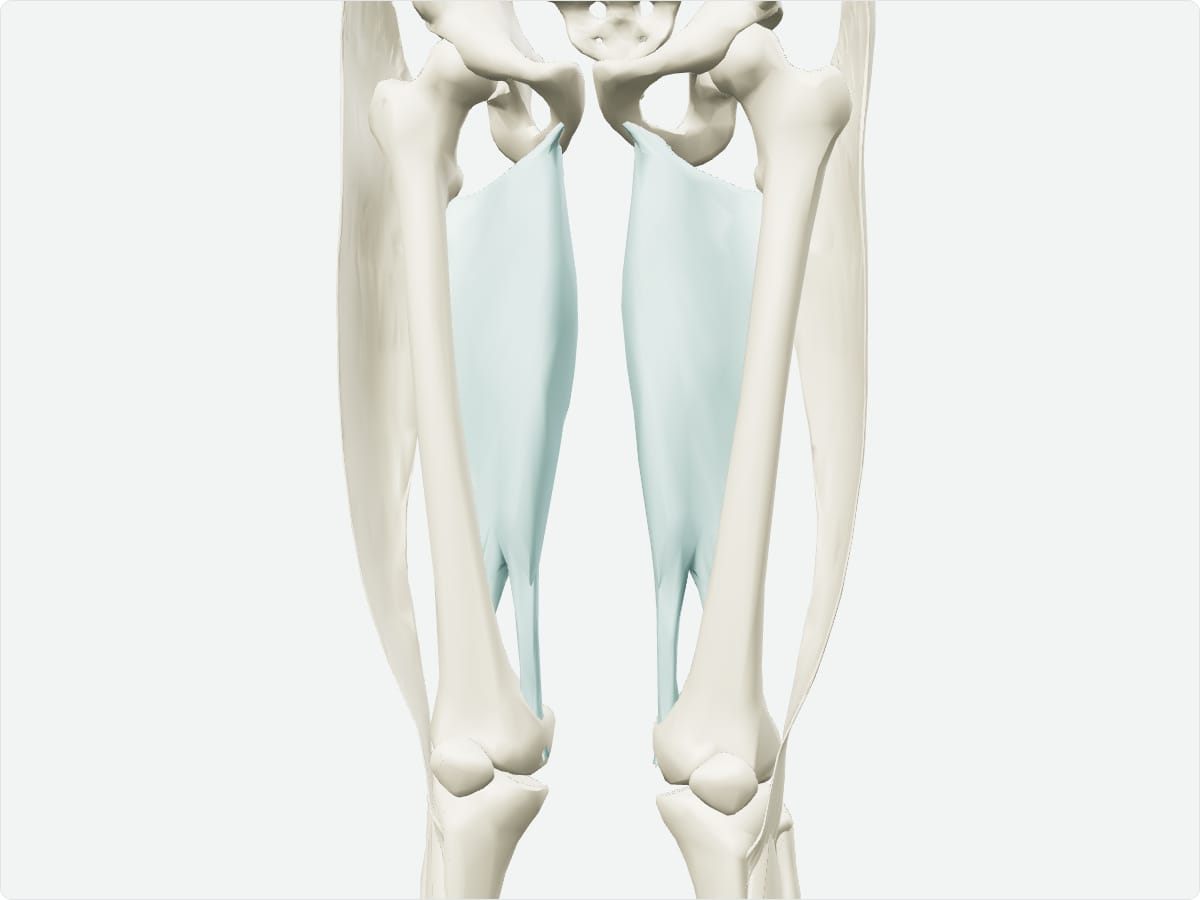
Adductor magnus: origin, insertion, nerve supply and action
Quick answer
The adductor magnus is the largest and most posterior of the adductor muscles of the thigh. It arises from the ischiopubic ramus and ischial tuberosity and inserts along the linea aspera and the adductor tubercle of the femur. It has a dual nerve supply: the obturator nerve to the adductor part and the tibial nerve to the hamstring part. It adducts the thigh and its hamstring part extends the hip.
Key facts
Origin
Inferior pubic ramus, ischial ramus and ischial tuberosity.
Insertion
Gluteal tuberosity, linea aspera and medial supracondylar line (adductor part); adductor tubercle of the femur (hamstring part).
Innervation
Adductor part: obturator nerve. Hamstring part: tibial division of the sciatic nerve (L2-L4).
Blood supply
Obturator artery, medial circumflex femoral artery and perforating branches of the profunda femoris.
Action
Adducts the thigh; the hamstring part extends the hip.
3D model: BodyParts3D (CC BY 4.0), adult male reference anatomy. Highlighted structure shown with nearby bones for context.
About the adductor magnus
The adductor hiatus, an opening between its two parts near the adductor tubercle, lets the femoral vessels pass to the popliteal fossa.
Clinical relevance
Groin strains commonly involve the adductor group in sports with sudden changes of direction.
Frequently asked questions
Why does the adductor magnus have two nerve supplies?
It is composed of an adductor part (obturator nerve) and a hamstring part (tibial division of the sciatic nerve).
What is the adductor hiatus?
A gap in the muscle's insertion through which the femoral artery and vein pass into the popliteal fossa.