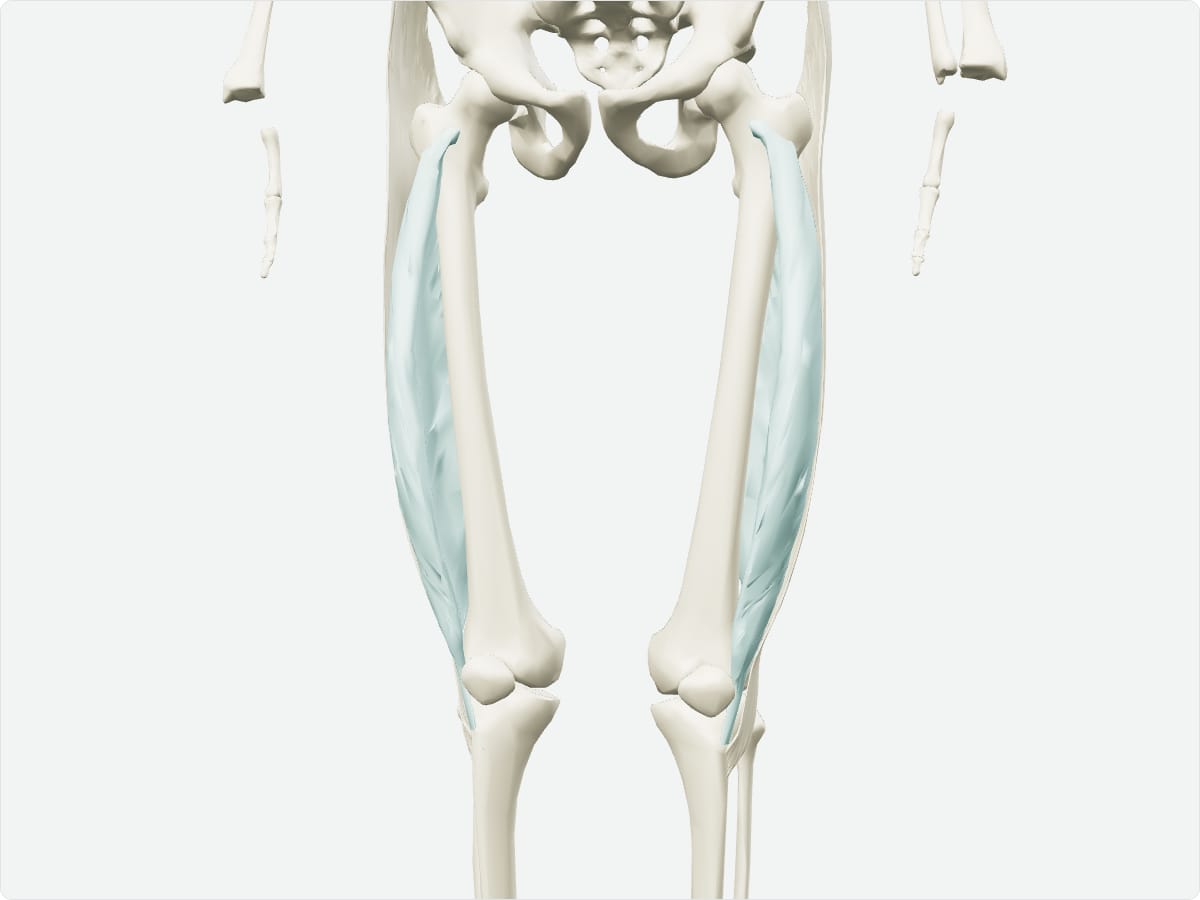
Vastus lateralis: origin, insertion, nerve supply and action
Musculus vastus lateralis
Quick answer
The vastus lateralis is the largest component of the quadriceps and forms the lateral bulk of the thigh. It arises from the greater trochanter and the lateral lip of the linea aspera and inserts on the tibial tuberosity through the quadriceps tendon, patella and patellar ligament. The femoral nerve supplies it, and it extends the knee.
Key facts
Origin
Greater trochanter, intertrochanteric line and lateral lip of the linea aspera of the femur.
Insertion
Quadriceps tendon, lateral border of the patella, and the tibial tuberosity via the patellar ligament.
Innervation
Femoral nerve (L2-L4).
Blood supply
Descending branch of the lateral circumflex femoral artery.
Action
Extends the knee.
3D model: BodyParts3D (CC BY 4.0), adult male reference anatomy. Highlighted structure shown with nearby bones for context.
About the vastus lateralis
Its thickness and distance from major vessels and nerves make the vastus lateralis the preferred intramuscular injection site in infants.
Clinical relevance
Injections into the vastus lateralis are given in the middle third of the lateral thigh.
Frequently asked questions
What does the vastus lateralis do?
It extends the knee.
Which nerve supplies the vastus lateralis?
The femoral nerve.
Study with AI
Answers come only from reviewed Anatly pages and can still contain mistakes. Not medical advice.